Technical Executive Summary: The global transition away from legacy polycarbonate and single-use takeaway plastics has triggered an unprecedented material revolution in reusable food containers. Brand owners face stringent regional regulations: the European Union’s Framework Regulation (EC) No 1935/2004, Germany’s LFGB Section 30/31, and the US FDA 21 CFR Chapter 177. This technical whitepaper compares the physical properties, chemical migration thresholds, and manufacturing costs of the three dominant material classes engineered at Naike Tableware.
1. Engineering Material Benchmarks
| Physical Property | Eastman Tritan™ (TX1001) | Microwave SUS 304 Steel | Wheat Straw Bio-Composite |
|---|---|---|---|
| Density (g/cm³) | 1.18 | 7.93 | 0.95 – 1.02 |
| Izod Notched Impact (J/m) | 850 (Virtually Unbreakable) | Ductile metallic yield | 65 – 85 (Drop resistant to 1.5m) |
| Service Temperature Span | -20°C to 100°C | -40°C to 300°C | -20°C to 120°C |
| Microwave Suitability | Yes (Under 3 mins reheat) | Yes (Certified smooth curved lip) | Yes (Full microwave reheat safe) |
| SPI Recycling Code | #7 (Other) | Ferrous / Metal Scrap (Infinite) | #5 (Polypropylene Stream) |
2. The Physics of Microwave-Safe Stainless Steel
Historically, metal containers were strictly prohibited from microwave ovens due to the risk of corona discharge electrical arcing, which occurs when intense electromagnetic fields concentrate at sharp metal points or edges.
Naike Tableware solves this engineering challenge through a patented curved aerodynamic rim geometry with a minimum radius of curvature ($R \ge 3.5\text{ mm}$). By eliminating all acute 90-degree corners and metal burrs, surface electrical potential gradients remain below the 30 kV/cm breakdown threshold of air. When tested under 1,000-Watt domestic microwave pulses for 5 consecutive minutes with food simulants, zero arcing, sparking, or container deformation occurs.
3. Agricultural Circular Economy: Wheat Straw Compounding
In Fujian and Northern agricultural hubs, wheat straw husk was traditionally burned as post-harvest waste. Naike Tableware partners with regional bio-refineries to reclaim and pulverize straw stalks into sub-100-mesh organic fibers.
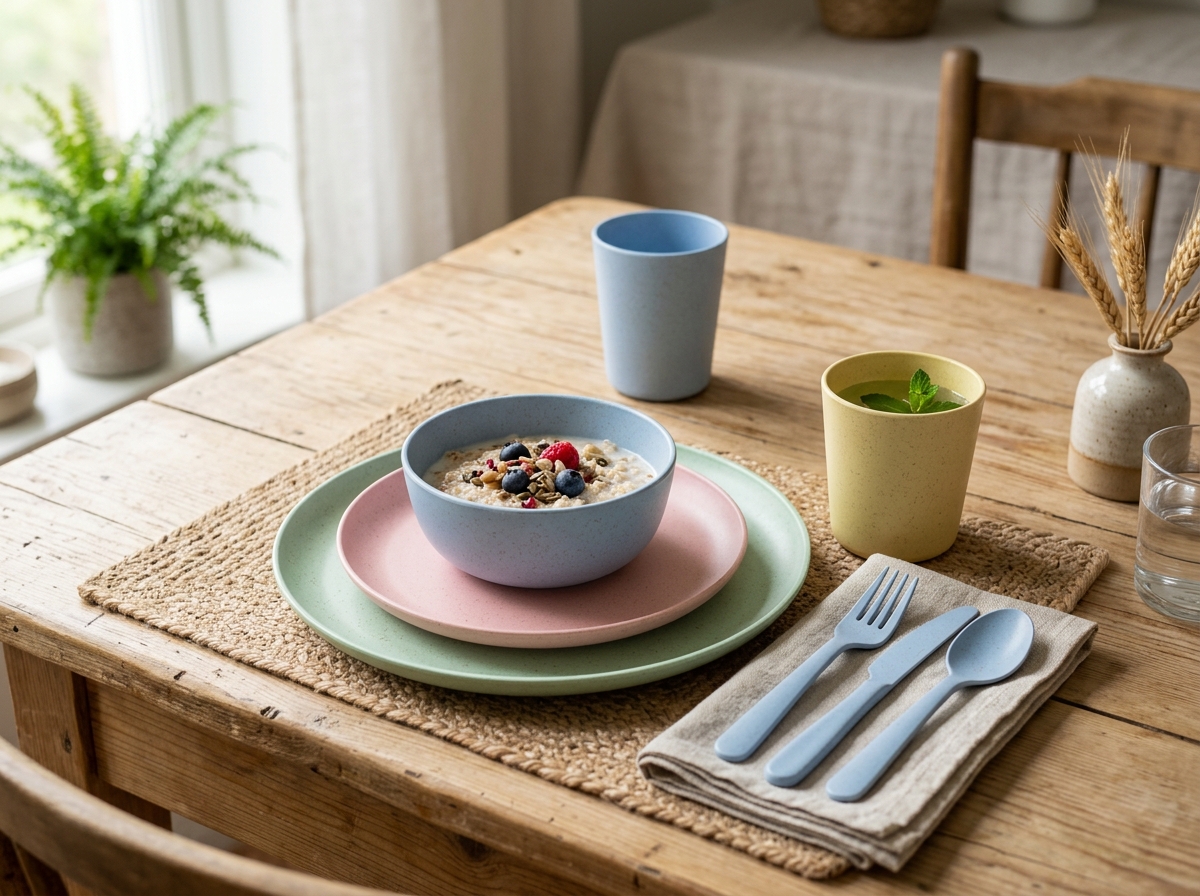
These bio-fibers are mechanically compounded with virgin polypropylene at a certified 35% ratio. The resulting polymer composite achieves a 38% reduction in life-cycle carbon emissions ($CO_2e$) compared to 100% petroleum polymers, while remaining fully recyclable within standard municipal polypropylene collection streams (#5 SPI).
Download Raw Material Certification Dossier
Includes full SGS/TÜV Rheinland migration test reports, LFGB certificates, and FDA compliance declarations.